
22Mn6 Material data
1 source records. Standards, editions and conditions are listed separately.
Material demand assessment
Looking for 22Mn6 material?
Not listed in our catalog? You are welcome to submit your requirements. We assess whether our equipment, production lines and process capabilities suit your grade, product form, dimensions, processing and delivery requirements, then discuss possible processing, trials or supply arrangements.
Feasibility and supply terms are confirmed after technical review. The standard information on this page is not a supply or performance commitment.
Keep your entries and try again later, or contact website@chqwire.net. If you have already received confirmation, do not submit again.
22Mn6 · ISO 683-3:2022
Chemical composition · Cast analysis
Mass fraction %; Table 3, page 17 of the user's PDF. Unlisted elements must not be treated as 0; intentional addition of unlisted elements is subject to the standard and ordering agreement.
| Element | Mass fraction / % |
|---|---|
| C | 0.18~0.25 |
| Si | ≤0.4 |
| Mn | 1.3~1.65 |
| P | ≤0.025 |
| S | ≤0.035 |
| Cr | ≤0.4 |
| Mo | ≤0.1 |
| Ni | ≤0.4 |
| Cu | ≤0.3 |
When A.4 is expressly selected in the order, Si≥0.10% may be agreed; the basic table still specifies Si≤0.40%.
Delivery conditions and hardness · Table 7
Brinell hardness. +S: treated to improve shearability; +A: soft annealed; +TH: treated to a specified hardness range; +FP: treated to a ferrite-pearlite structure; +N: normalized. “—” means no requirement is specified for that delivery condition.
| Delivery condition | Brinell hardness requirement |
|---|---|
| +S | — |
| +A | ≤197 |
| +TH | 149~197 |
| +FP | — |
| +N | — |
Heat treatment and test-piece conditions · Table 8
| Item | Temperature / ℃ |
|---|---|
| Austenitizing temperature for the end-quench test | — |
| Carburizing temperature (guidance) | 880~980 |
| Direct and first quenching temperature (guidance) | 830~870 |
| Second quenching: core quenching temperature (guidance) | 880~920 |
| Second quenching: case quenching temperature (guidance) | 780~820 |
| Tempering temperature (guidance) | 150~200 |
Except for the end-quench austenitizing temperature, carburizing, quenching and tempering temperatures are guidance values; the actual process must achieve the required properties. Guidance holding times are at least 30 minutes for austenitizing and at least 1 hour for tempering. Select the quenching medium according to product shape, cooling conditions and furnace load.
Hardenability conditions · Tables 5 and 6
Tables 5 and 6 do not specify a hardenability band for this grade. Do not apply the band of another grade.
Permissible deviations in product analysis · Table 4
| Element | Specified cast-analysis range / % | Permissible product-analysis deviation / % |
|---|---|---|
| C | 0.07<C≤0.31 | ±0.02 |
| Si | ≤0.40 | ±0.03 |
| Mn | ≤1.00 / >1.00~1.65 | ±0.04 / ±0.06 |
| P | ≤0.025 | +0.005 |
| S | ≤0.040 | ±0.005 |
| Cr | ≤1.80 | ±0.05 |
| Mo | ≤0.30 / >0.30~0.50 | ±0.03 / ±0.04 |
| Ni | ≤1.00 / >1.00~2.00 / >2.00~3.50 | ±0.03 / ±0.05 / ±0.07 |
| Cu | ≤0.40 | +0.05 |
| B | ≤0.0050 | ±0.0003 |
“±” permits a deviation for a single cast above the upper limit or below the lower limit, in one direction only. Product-analysis deviations do not change the cast-analysis limits in Table 3.
Standard edition and ordering notes
- ISO 683-3:2022; the user-supplied file is the EN ISO 683-3:2022 adoption. Requirements from different editions are listed separately; existing sources are retained.
- The 2022 edition removes the minimum silicon content from Table 3. The basic requirement is Si≤0.40%; the minimum in Annex A.4 applies only as an expressly agreed ordering option.
- Annex A.4 prints 15MnCrS5 and 18CrMo7-6, which differ from the grade designations in Table 3. This page does not silently correct them or assign a minimum silicon content automatically; additional requirements must be agreed by purchaser and supplier.
- When ordered to hardenability requirements, Table 3, footnote a permits limited minor composition deviations: excluding P and S, C ±0.01%, and other elements within the Table 4 limits. These are not default ranges for ordinary orders.
- High-sulfur or lead-added free-cutting variants apply only at the purchaser's request and subject to agreement; they do not replace the ordinary composition ranges shown here.
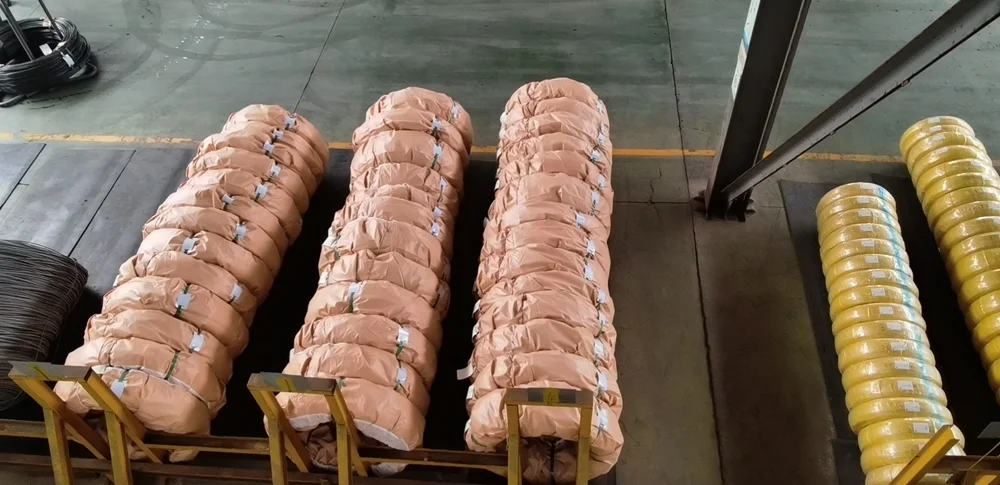
The standard covers products including wire rod. Finished cold-heading wire supply, processing and properties require technical review and order confirmation. — means not specified in this table, not 0.
Source comparison: reviewed by Codex against the standard supplied by the user. This webpage does not replace the official standard, order agreement or inspection certificate.