1. Chemical composition and applicable practices
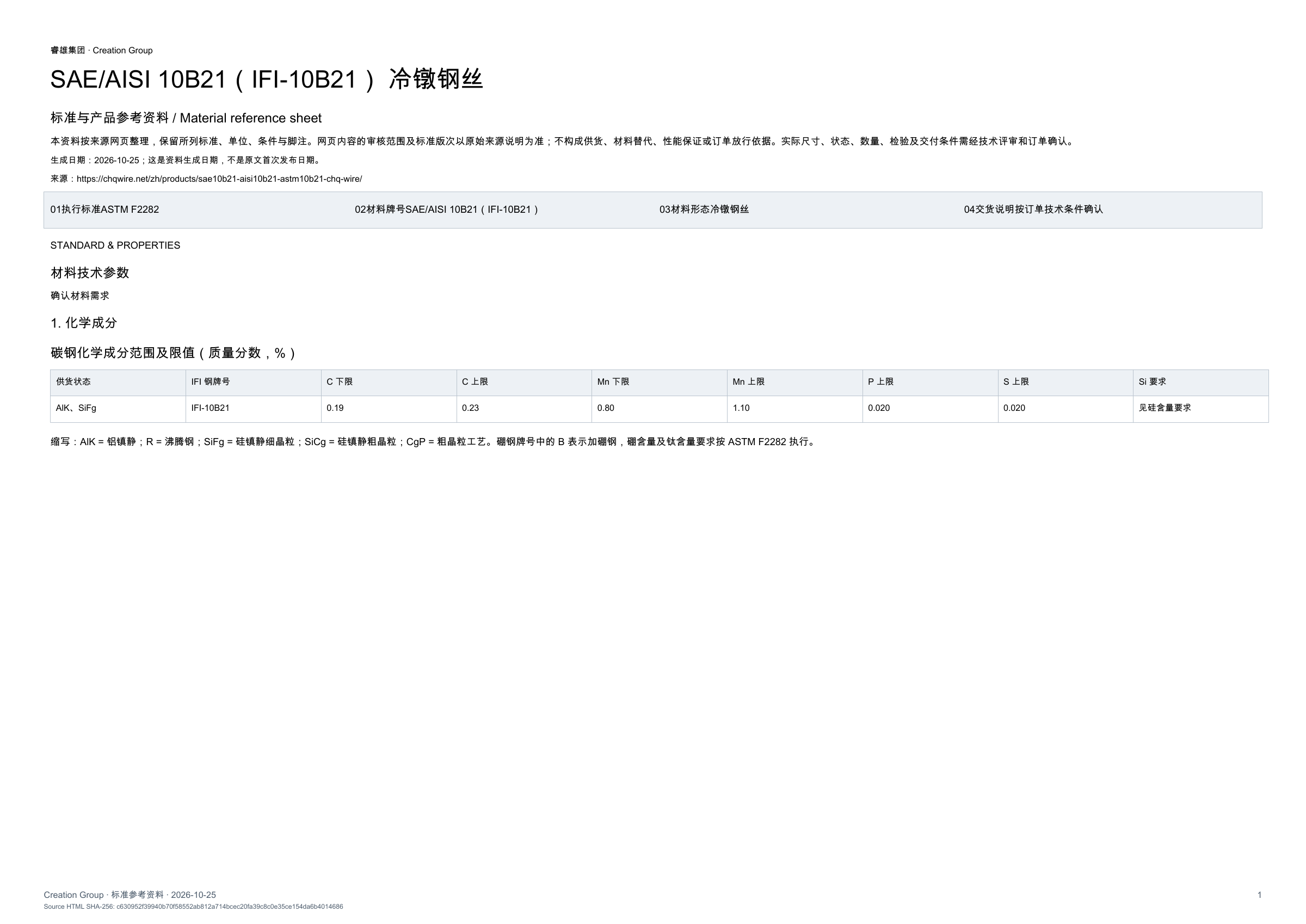
IFI-10B21 reference requirements under ASTM F2282-18; mass fraction in percent. These are not measured heat-analysis results. Legacy SAE/AISI catalogue labels do not establish equivalence: ASTM F2282 explicitly notes that IFI composition ranges may differ from SAE or AISI ranges. Confirm the exact grade, edition and requirements in the order.
Table 4 – Chemical ranges and limits
| IFI grade | C min. | C max. | Mn min. | Mn max. | P max. | S max. |
|---|---|---|---|---|---|---|
| IFI-10B21 | 0.19 | 0.23 | 0.80 | 1.10 | 0.020 | 0.020 |
A dash means no numerical limit is specified in this source cell; it does not mean zero content.
Permitted conditions furnished: AlK, SiFg. AlK = aluminum killed; R = rimmed steel; SiFg = silicon-killed fine-grain practice; SiCg = silicon-killed coarse-grain practice; CgP = coarse-grain practice.
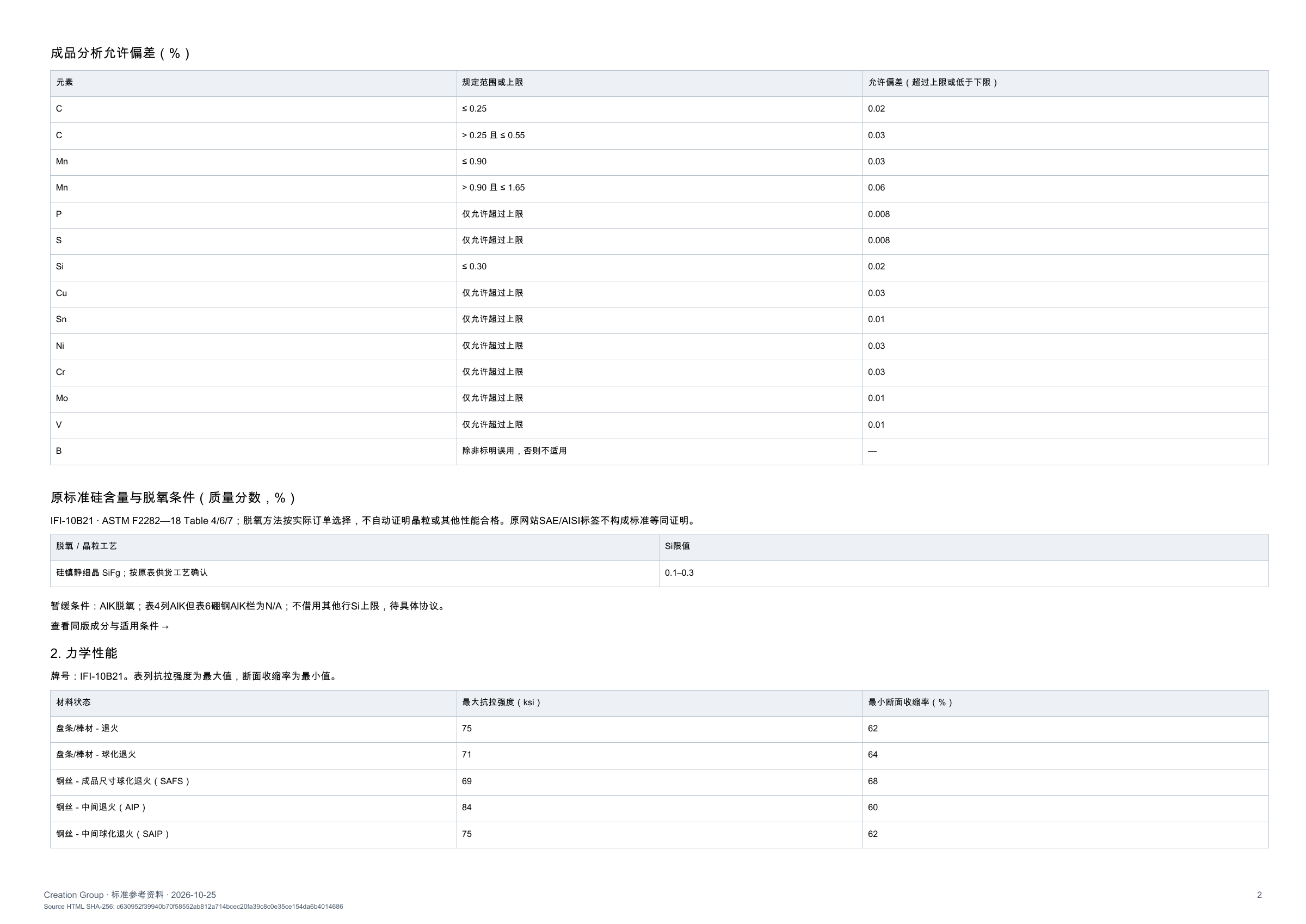
Table 6 – Silicon limits for this grade’s permitted practices, %
| Deoxidation/grain practice | Silicon limit |
|---|---|
| SiFg | 0.10–0.30 |
Source discrepancy for IFI-10B21: Table 4 lists AlK, but the corresponding boron-grade field in Table 6 is N/A. No silicon limit from another row is substituted. This condition requires specific technical agreement before ordering.
The B inserted between the first and last two digits identifies an intentionally boron-added grade. Table 4 requires B 0.0008–0.003% together with Ti ≥0.01%.
Table 5 – Permissible variations for product analysis, %
| Element | Specified limit/range | Permissible variation |
|---|---|---|
| C | ≤0.25 | ±0.02 |
| C | >0.25 and ≤0.55 | ±0.03 |
| Mn | ≤0.90 | ±0.03 |
| Mn | >0.90 and ≤1.65 | ±0.06 |
| P | Above maximum only | +0.008 |
| S | Above maximum only | +0.008 |
| Si | ≤0.30 | ±0.02 |
| Cu | Above maximum only | +0.03 |
| Sn | Above maximum only | +0.01 |
| Ni | Above maximum only | +0.03 |
| Cr | Above maximum only | +0.03 |
| Mo | Above maximum only | +0.01 |
| V | Above maximum only | +0.01 |
| B | Not applicable unless misapplication is indicated | N/A |
For a range, the variation may occur above the maximum or below the minimum; results for the same heat must not vary in both directions. For phosphorus and sulfur, only an excess above the specified maximum is permitted within the listed allowance. Under clause 6.4.2, product analysis is generally unsuitable for carbon, phosphorus and sulfur in rimmed or capped steels unless misapplication is clearly indicated. Source: ASTM F2282-18, clause 6 and Tables 4–9, pages 3–5.
2. Mechanical properties
Table 11 – IFI-10B21 in the specified delivery conditions
| Material condition | Maximum tensile strength, ksi | Minimum reduction of area, % |
|---|---|---|
| Wire rod/bar – annealed | 75 | 62 |
| Wire rod/bar – spheroidize annealed | 71 | 64 |
| Wire – spheroidize annealed at finished size (SAFS) | 69 | 68 |
| Wire – annealed in process, then lightly drawn to finished size (AIP) | 84 | 60 |
| Wire – spheroidize annealed in process, then lightly drawn to finished size (SAIP) | 75 | 62 |
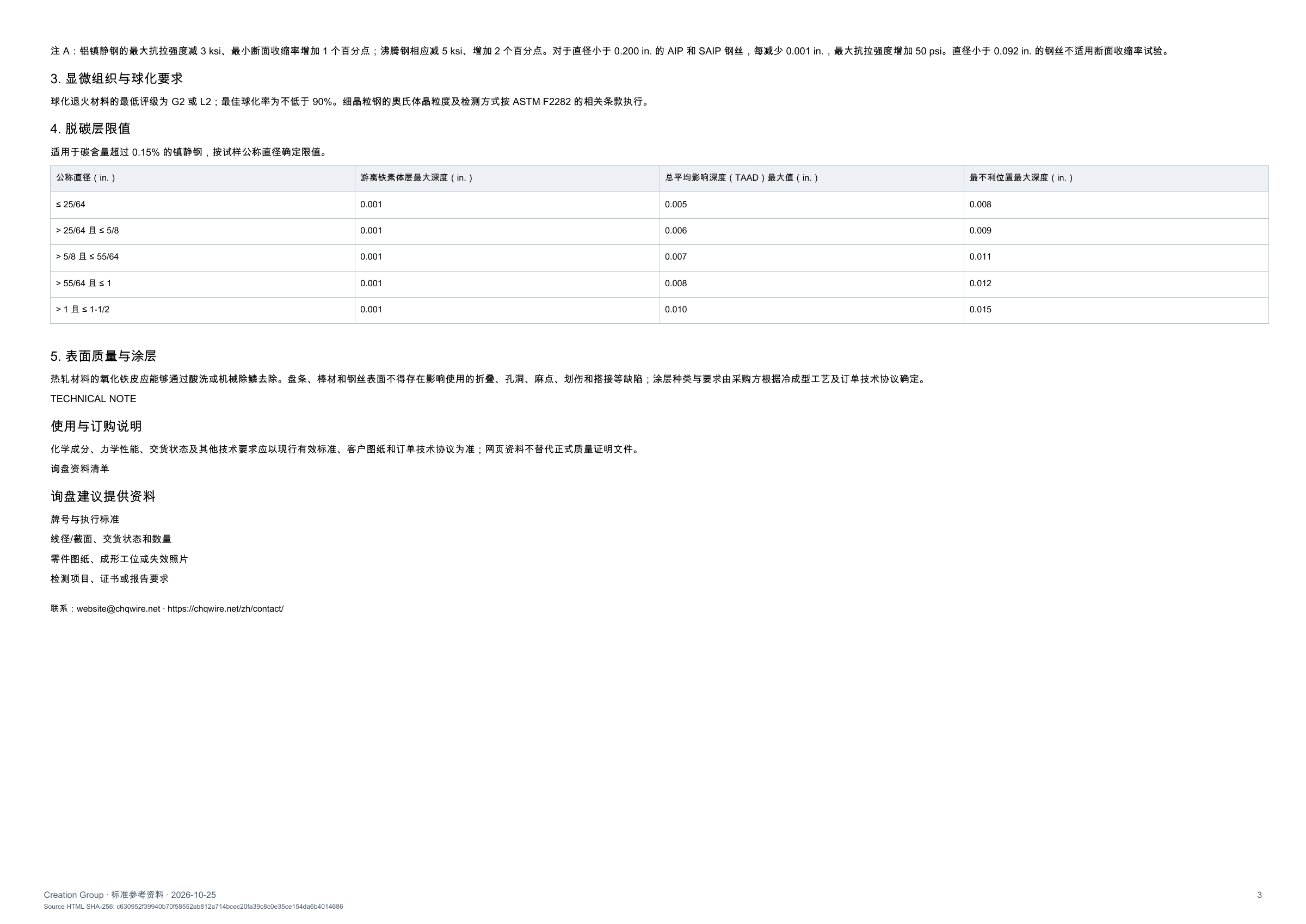
For aluminum-killed steel, subtract 3 ksi from the tensile-strength limit and add 1 percentage point to the reduction-of-area minimum. For rimmed steel, subtract 5 ksi and add 2 percentage points, respectively. For AIP and SAIP wire below 0.200 in., add 50 psi to the tensile-strength limit for every 0.001 in. below 0.200 in. Reduction-of-area testing does not apply to wire below 0.092 in. Source: ASTM F2282-18, Table 11, page 9. The table uses ksi, while the diameter adjustment uses psi; these units are not interchangeable.
3. Microstructure and spheroidization
Clause 7.3.1 requires a minimum spheroidization rating of G2 or L2 against IFI Plate 1. Clause 7.3.2 describes spheroidization of at least 90% as optimum; it is not a separate mandatory 90% acceptance threshold. Percentage ratings are approximate visual assessments. Austenitic grain size and testing must follow the specified practice and ASTM E112. Source: ASTM F2282-18, clauses 7.2–7.3 and Plate 1, pages 4–7.
4. Decarburization limits
Table 10 applies to killed steels with carbon content exceeding 0.15%. Applicability must be assessed for the actual grade, heat composition and condition. All diameters and depths in this table are in inches; they are not millimetres.
| Nominal diameter, in. | Maximum free-ferrite depth, in. | Maximum total average affected depth (TAAD), in. | Maximum worst-location depth, in. |
|---|---|---|---|
| ≤25/64 | 0.001 | 0.005 | 0.008 |
| >25/64 and ≤5/8 | 0.001 | 0.006 | 0.009 |
| >5/8 and ≤55/64 | 0.001 | 0.007 | 0.011 |
| >55/64 and ≤1 | 0.001 | 0.008 | 0.012 |
| >1 and ≤1½ | 0.001 | 0.010 | 0.015 |
Measure and evaluate decarburization according to Section 8. Source: ASTM F2282-18, Table 10, page 8. TAAD and worst-location depth are separate limits; neither is a case-hardening depth.
5. Surface condition and coating
Mill scale on hot-rolled material must be removable by acid pickling or mechanical descaling. Surface contaminants must not impede cleaning or contaminate the pickle bath. Bar, rod and wire must be free from detrimental imperfections such as seams, voids, pits, scratches and laps. Coating requirements are specified by the purchaser for the forming process and order. Source: ASTM F2282-18, Sections 11–13, page 8.
These excerpts are standard references, not batch certificates, a supply commitment or approval of material substitution. The complete standard and technical order agreement govern the assessment.