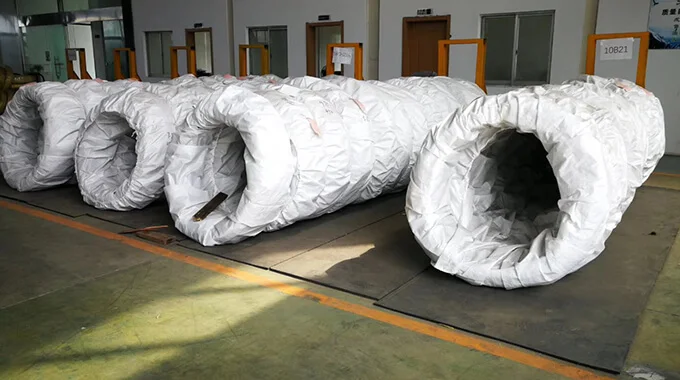
Technical data for SNB7 wire rod for cold forming, compliant with JIS G4107. View the chemical composition, mechanical properties, and related technical requirements for this grade.
Supply and technical review · Creation Group accepts supply and technical review enquiries for this product. Dimensions, delivery condition, quantity and inspection documents are confirmed in the order technical agreement after review.
Reference composition for the stated standard edition, not heat analysis. Confirm the order standard and the separate requirements for feedstock and finished product.
Source: JIS G4107-2007 · SNB7 · p.1,2
Element
Mass fraction / %
C
0.38–0.48
Si
0.2–0.35
Mn
0.75–1
P
≤0.04
S
≤0.04
Cr
0.8–1.1
Mo
0.15–0.25
C · d>90 mm · Table 3 b
Cmax 0.50%
Note a) Elements not specified in this table shall not be intentionally added to the steel, except for the purpose of completing the melt, unless agreed upon by both the supplier and the purchaser. b) For SNB7, the upper limit of carbon content may be 0.50% when the diameter of the bolt material exceeds 90 mm.
2. Mechanical properties of wire rod
Table 4 -- Mechanical Properties
3. Dimensional Tolerances
Table 6 -- Dimensional Tolerances for Hot-Rolled Wire Rod
Diameter
Diameter tolerance
Out-of-roundness
<15
±0.3
<0.4
15<d≤25
±0.4
<0.5
25<d≤32
±0.5
<0.6
32<d≤50
±0.6
<0.7
For diameters exceeding 50 mm, subject to agreement between supplier and purchaser. Note a) Out-of-roundness refers to the difference between the maximum and minimum diameters measured on the same cross-section of the wire rod.
TECHNICAL NOTE
Application and ordering note
Chemical composition, mechanical properties, delivery condition and other technical requirements are subject to the currently applicable standard edition, customer drawings and the order technical agreement. Website information does not replace formal quality certification documents.
RFQ CHECKLIST
What to include in the enquiry
Grade and applicable standard
Diameter or section, delivery condition and quantity
Part drawing, forming stations or failure photos, if available
Testing, certificate or report requirements
RELATED CAPABILITIES
Related manufacturing and quality capabilities
Carbon equivalent calculator — SNB7
Basis: JIS G4107
Chemical composition source: JIS G4107-2007
Transcribed from the cited standard
The product does not specify a standard edition. Composition uses the verified source edition explicitly cited here. Confirm the contract edition separately; do not assume other editions are identical.
Original source wording
Applicable diameters in Table 1; heat analysis in Table 3 and Notes a/b
IIW / CEV
CEV = C + Mn/6 + (Cr + Mo + V)/5 + (Ni + Cu)/15
Confirm the applicable product conditions before calculating the carbon equivalent.
Product dimensions or processing conditions
IIW/CEV: carbon and low-alloy steel weldability screening.
Pcm (Ito–Bessyo)
Pcm = C + Si/30 + (Mn + Cu + Cr)/20 + Ni/60 + Mo/15 + V/10 + 5B
Confirm the applicable product conditions before calculating the carbon equivalent.
Product dimensions or processing conditions
Pcm: mainly low-carbon, low-alloy steels; confirm applicability, particularly when C exceeds 0.11%.
CET
CET = C + (Mn + Mo)/10 + (Cr + Cu)/20 + Ni/40
Confirm the applicable product conditions before calculating the carbon equivalent.
Product dimensions or processing conditions
CET: ferritic-steel preheat assessment; confirm EN 1011-2 conditions.
A stated upper limit means 0 to that limit. A lower limit alone does not define an upper bound. Missing elements are unknown, not zero. Standard-limit combinations are not measured heat results.
Carbon equivalent supports weldability assessment; it does not approve cold heading, fastener strength or a welding procedure. These formulas do not directly apply to stainless steels, cast irons or non-ferrous metals.