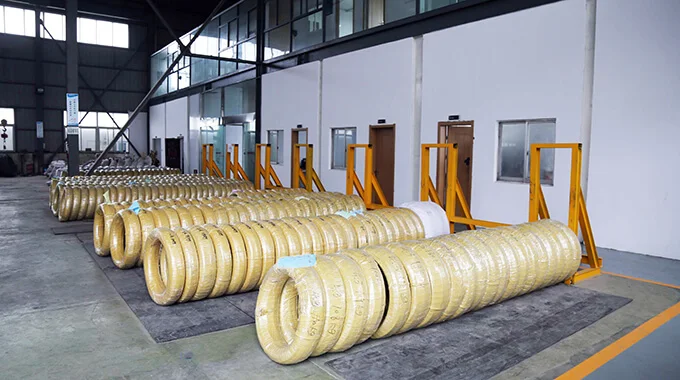
Technical data for SWCH20A wire rod for cold forming, compliant with JIS G 3507-2:2005. View the chemical composition, mechanical properties, and related technical requirements for this grade.
Supply and technical review · Creation Group accepts supply and technical review enquiries for this product. Dimensions, delivery condition, quantity and inspection documents are confirmed in the order technical agreement after review.
Reference composition for the stated standard edition, not heat analysis. Confirm the order standard and the separate requirements for feedstock and finished product.
Source: JIS G 3507-2:2005 → JIS G 3507-1:2021 · SWRCH20A · p.7
Element
Mass fraction / %
C
0.18~0.23
Si
≤0.10
Mn
0.30~0.60
P
≤0.030
S
≤0.035
Cr
≤0.20
Ni
≤0.20
Cu
≤0.30
Al
≥0.02
For all steel grades in this table, Cu shall not exceed 0.30%, Ni 0.20%, and Cr 0.20%.
2. Mechanical properties of wire rod
Table 2 Mechanical properties of wire rod resulting from Process D
Grade
Wire diameter range mm
Tensile Strength N/mm²
Reduction of Area %
(Reference) Hardness HRB
SWCH20A
≤3
≥690
—
—
SWCH20A
>3–4
≥590
≥45
—
SWCH20A
>4–5
≥490
≥45
—
SWCH20A
>5
≥410
≥45
≤92
Notes: 1. For wire diameters exceeding 20 mm, the tolerance is the value in Table 2 minus 5. No tolerance is specified for diameters of 3 mm or less. 2. 1 N/mm² = 1 MPa
Table 3 Mechanical properties of wire rod resulting from the DA process
Grade
Tensile Strength N/mm²
Reduction of Area %
(Reference) Hardness HRB
SWCH20A
≥370
≥55
≤85
Notes: 1. For SWCH6R to SWCH27K grades, when the product is used as heat-treated wire, the lower limit of tensile strength may be set below the values in Table 3 upon agreement between supplier and purchaser. 2. For wire diameters exceeding 20 mm, the tolerance is the value in Table 3 minus 5. No tolerance is specified for diameters of 3 mm or less. 3. 1 N/mm² = 1 MPa
3. Depth of decarburized layer
Table 4 Permissible limits for average decarburized layer depth
Unit: mm
Wire diameter
Ferrite decarburized layer depth
Total decarburized layer depth
≤15
≤0.02
≤0.15
>15~25
≤0.03
≤0.20
>25~32
≤0.04
≤0.25
For SWCH30K to SWCH50K wire, when specified by the purchaser, the test in 10.3.1 shall be performed. The permissible limit for the average decarburized layer depth shall be in accordance with Table 4. However, for wire with a diameter exceeding 32 mm, the limits shall be agreed upon between the supplier and the purchaser.
4. Tolerance on wire diameter and out-of-roundness
Table 5 Tolerance on wire diameter and out-of-roundness
Wire diameter
Permissible deviation
Out-of-roundness
≤3
+0 / −0.025
≤0.013
>3–6
+0 / −0.030
≤0.015
>6–10
+0 / −0.036
≤0.018
>10–18
+0 / −0.043
≤0.022
>18–30
+0 / −0.070
≤0.035
>30–40
+0 / −0.100
≤0.050
>40–50
+0 / −0.150
≤0.070
Note (4): Diameter deviation refers to the difference between the maximum and minimum diameters measured on the same cross-section of the wire.
TECHNICAL NOTE
Application and ordering note
Chemical composition, mechanical properties, delivery condition and other technical requirements are subject to the currently applicable standard edition, customer drawings and the order technical agreement. Website information does not replace formal quality certification documents.
RFQ CHECKLIST
What to include in the enquiry
Grade and applicable standard
Diameter or section, delivery condition and quantity
Part drawing, forming stations or failure photos, if available
Testing, certificate or report requirements
RELATED CAPABILITIES
Related manufacturing and quality capabilities
Carbon equivalent calculator — SWCH20A
Basis: JIS G 3507-2:2005
Chemical composition source: JIS G 3507-2:2005 → JIS G 3507-1:2021
Transcribed from the cited standard
Original source wording
Table 2
IIW / CEV
CEV = C + Mn/6 + (Cr + Mo + V)/5 + (Ni + Cu)/15Known-element contribution, not a complete value: 0.2300–0.4033
Missing elements: Mo, V
IIW/CEV: carbon and low-alloy steel weldability screening.
Pcm (Ito–Bessyo)
Pcm = C + Si/30 + (Mn + Cu + Cr)/20 + Ni/60 + Mo/15 + V/10 + 5BKnown-element contribution, not a complete value: 0.1950–0.2917
Missing elements: Mo, V, B
Pcm: mainly low-carbon, low-alloy steels; confirm applicability, particularly when C exceeds 0.11%.
CET
CET = C + (Mn + Mo)/10 + (Cr + Cu)/20 + Ni/40Known-element contribution, not a complete value: 0.2100–0.3200
Missing elements: Mo
CET: ferritic-steel preheat assessment; confirm EN 1011-2 conditions.
A stated upper limit means 0 to that limit. A lower limit alone does not define an upper bound. Missing elements are unknown, not zero. Standard-limit combinations are not measured heat results.
Carbon equivalent supports weldability assessment; it does not approve cold heading, fastener strength or a welding procedure. These formulas do not directly apply to stainless steels, cast irons or non-ferrous metals.