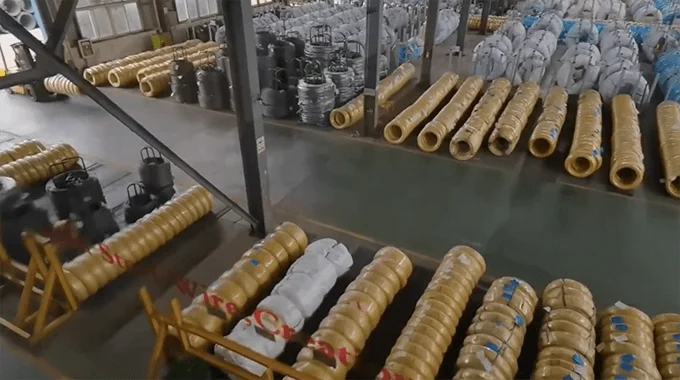
Technical data for SCM435 Steel for cold forming, compliant with JIS G4053. View the chemical composition, mechanical properties, and related technical requirements of the current grade.
Supply and technical review · Creation Group accepts supply and technical review enquiries for this product. Dimensions, delivery condition, quantity and inspection documents are confirmed in the order technical agreement after review.
Elements not specified in this table shall not be intentionally added, except where necessary for steelmaking purposes. Note a) Shall not be intentionally added. b) For SNCM630, the lower limit for Mo may be 0.30% upon agreement between supplier and purchaser. c) Al content for SACM645 is 0.70% ~ 1.20%.
2. Mechanical properties of wire rod
Mechanical property values shall be determined by agreement between the supplier and the purchaser.
3. Dimensional Tolerances
Table 8 - Dimensional tolerances for hot-rolled wire rod
Diameter
Diameter tolerance
Out-of-roundness
<15
±0.3
<0.4
15<d≤25
±0.4
<0.5
25<d≤32
±0.5
<0.6
32<d≤50
±0.6
<0.7
Tolerances for wire rod with a diameter exceeding 50 mm shall be determined by agreement between the supplier and the purchaser. Note a) Out-of-roundness refers to the difference between the maximum and minimum diameters measured on the same cross-section of the wire rod.
Engineering Knowledge
Cold Heading Material Engineering Classroom
FAQ
Frequently Asked Questions
What product form is shown for SCM435 on the page?
The page lists SCM435 as wire rod, not cold heading wire (CHQ wire). This is the initial product form — hot-rolled rod used as input for cold forming processes. There is also a separate SCM435WCH page on the site; that variant follows JIS G3509 and includes hardenability and decarburization control categories in the material data, making it more directly aligned with cold heading applications.
What standard is referenced on the SCM435 page?
The page references JIS G4053 — Carbon and Alloy Steels for Machine Structural Purposes. The main alloying elements are chromium (Cr) and molybdenum (Mo).
Are the mechanical properties for SCM435 fixed on the page?
No, they are not fixed. The 'Technical Delivery Condition' field on the page is empty. JIS G4053 indicates that mechanical property values for SCM435 are to be agreed between buyer and seller at the time of order. Buyers should provide specific mechanical property requirements when inquiring, to be confirmed by the supplier.
What is the relationship between SCM435 and SCM435WCH on the site?
Both are listed as wire rod, but under different standards: SCM435 follows JIS G4053 and SCM435WCH follows JIS G3509. The material data for SCM435WCH includes hardenability and decarburization control categories, indicating it is suited for cold heading use. If your application has hardenability or decarburization requirements, consult with the supplier to confirm whether the JIS G3509 variant (SCM435WCH) is appropriate.
What should a buyer provide when requesting SCM435 wire rod?
For an accurate quotation, provide: ① Grade and standard (JIS G4053); ② Target size, dimensional tolerance, and delivery-condition requirements (JIS G4053 contains dimensional tolerance provisions; the applicable specifications should be confirmed before quotation); ③ Surface quality requirements (smooth, seamless, no seams/scratches/dents); ④ Mechanical-property requirements; ⑤ Packaging preference (coils / straight lengths / wooden crates). More detail leads to a more accurate quotation.
Chemical composition, mechanical properties, delivery condition and other technical requirements are subject to the currently applicable standard edition, customer drawings and the order technical agreement. Website information does not replace formal quality certification documents.
RFQ CHECKLIST
What to include in the enquiry
Grade and applicable standard
Diameter or section, delivery condition and quantity
Part drawing, forming stations or failure photos, if available
Testing, certificate or report requirements
RELATED CAPABILITIES
Related manufacturing and quality capabilities
Carbon equivalent calculator — SCM435
Basis: JIS G4053
Chemical composition source: JIS G 4053-2008
Transcribed from the cited standard
The product does not specify a standard edition. Composition uses the verified source edition explicitly cited here. Confirm the contract edition separately; do not assume other editions are identical.
Original source wording
Table 2 and its continuation, Notes a/b; Clause 5
IIW / CEV
CEV = C + Mn/6 + (Cr + Mo + V)/5 + (Ni + Cu)/15Known-element contribution, not a complete value: 0.6400–0.8667
Missing elements: V
IIW/CEV: carbon and low-alloy steel weldability screening.
Pcm (Ito–Bessyo)
Pcm = C + Si/30 + (Mn + Cu + Cr)/20 + Ni/60 + Mo/15 + V/10 + 5BKnown-element contribution, not a complete value: 0.4200–0.5358
Missing elements: V, B
Pcm: mainly low-carbon, low-alloy steels; confirm applicability, particularly when C exceeds 0.11%.
CET
CET = C + (Mn + Mo)/10 + (Cr + Cu)/20 + Ni/40Calculated range: 0.4500–0.5813
CET: ferritic-steel preheat assessment; confirm EN 1011-2 conditions.
A stated upper limit means 0 to that limit. A lower limit alone does not define an upper bound. Missing elements are unknown, not zero. Standard-limit combinations are not measured heat results.
Carbon equivalent supports weldability assessment; it does not approve cold heading, fastener strength or a welding procedure. These formulas do not directly apply to stainless steels, cast irons or non-ferrous metals.