
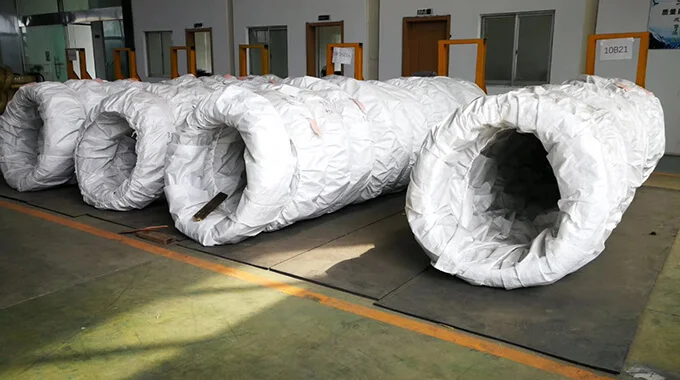
1. Delivery conditions and applicable requirements
Table 1 – Delivery conditions, product forms and applicable requirements
| Heat-treatment condition | Symbol | Wire rod | Bar | Wire |
|---|---|---|---|---|
| Untreated | None or +U | X | X | X |
| Spheroidize annealed | +AC | X | X | X |
| Treated to a ferrite-pearlite structure and specified hardness range | +FP | — | X | — |
| Basis of order | Applicable requirements |
|---|---|
| Table 3, 5 or 6 or 7 | Chemical composition according to Tables 3 and 4; mechanical properties according to Table 5, 6 or 7. |
| Table 3, 5 or 6 or 7, 8 or 9 | Chemical composition according to Tables 3 and 4; mechanical properties according to Table 5, 6 or 7; hardenability according to Table 8 or 9. |
| Table 3, 5, 6, 7, 8 or 9 | Supplementary or special requirements under Annex A of EN 10263-1:2017, if agreed at the time of enquiry and order. |
Table 2 – Surface condition at delivery
| Basis of agreement | Surface condition | Symbol | Bar | Wire rod | Wire |
|---|---|---|---|---|---|
| Unless otherwise agreed | As rolled | None or +AR | X | X | — |
| Special surface condition by agreement | Cold drawn | +C | X | — | X |
| Special surface condition by agreement | Lightly cold drawn | +LC | X | — | X |
| Special surface condition by agreement | Peeled | +PE | X | X | X |
X = applicable; — = not applicable. Other delivery conditions may be agreed at the time of order.
Heat-treatment condition and surface condition are separate requirements. This table gives the standard reference; the actual product form, delivery condition and suitability must be confirmed in the order.
Source: EN 10263-3:2017, Table 1 and 2, page 7–8 (PDF page 9–10).
2. Chemical composition
Table 3 – Chemical composition of case-hardening steels (cast analysis)
Reference requirements for C17E2C, steel number 1.1147. These are not analysis results for a particular heat. The order standard and requirements for raw material and finished product must be confirmed separately.
| Element | Mass fraction, % |
|---|---|
| C | 0.15–0.19 |
| Si | ≤0.30 |
| Mn | 0.60–0.90 |
| P | ≤0.025 |
| S | ≤0.025 |
| Cr | — |
| Mo | — |
| Ni | — |
| B | — |
| Cu | ≤0.25 |
Values are mass fractions in percent. Single values are maximum limits unless otherwise indicated. “—” represents a blank source field and does not mean zero content.
Elements not listed must not be intentionally added without the purchaser’s agreement, except for finishing the heat. Appropriate precautions are required to prevent additions from scrap or other production materials that could impair hardenability, mechanical properties or suitability.
For steels with hardenability requirements under Tables 8 and 9, small departures from the composition limits are permitted, except for sulfur and phosphorus. Departures must not exceed 0.01% for carbon or the values in Table 4 for the other elements.
An aluminium addition of 0.020–0.050% is possible to improve cold-heading performance.
A lower silicon content or a specified silicon range may be agreed at the time of order.
Table 4 – Permissible deviations for product analysis
| Element | Limiting values for cast analysis, % | Permissible deviation for product analysis, % |
|---|---|---|
| C | ≤0.24 | ±0.02 |
| Si | ≤0.30 | ±0.03 |
| Mn | ≤1.00 | ±0.04 |
| Mn | >1.00 and ≤1.40 | ±0.06 |
| P | ≤0.025 | +0.005 |
| S | ≤0.040 | +0.005 |
| Cr | ≤1.70 | ±0.05 |
| Mo | ≤0.30 | ±0.03 |
| Mo | >0.30 and ≤0.50 | ±0.04 |
| Ni | ≤1.00 | ±0.03 |
| Ni | >1.00 and ≤1.70 | ±0.05 |
| B | ≤0.0050 | ±0.0003 |
| Cu | ≤0.25 | +0.03 |
± means that, within one heat, the product analysis for an element may deviate above the upper limit or below the lower limit in Table 3, but not in both directions at the same time.
For steels with a specified sulfur range of 0.020–0.040% in the cast analysis, the permissible deviation is ±0.005%.
Source: EN 10263-3:2017, Table 3 on page 8 (PDF page 10), and Table 4 on page 10 (PDF page 12). These tables do not replace the complete standard.
3. Mechanical properties
Table 5 – Mechanical properties of non-alloy steels in the specified delivery condition
| Steel name | Steel number | Diameter | Delivery condition | ||||||||||||
|---|---|---|---|---|---|---|---|---|---|---|---|---|---|---|---|
| +U or +PE | +AC or +AC+PE | +U+C | +U+C+AC | +U+C+AC+LC | +AC+C | ||||||||||
| over, mm | up to and including, mm | Rm max., MPa | Z min., % | Rm max., MPa | Z min., % | Rm max., MPa | Z min., % | Rm max., MPa | Z min., % | Rm max., MPa | Z min., % | Rm max., MPa | Z min., % | ||
| C17E2C | 1.1147 | 2 | 5 | — | — | — | — | — | — | 440 | 67 | 480 | 65 | — | — |
| C17E2C | 1.1147 | 5 | 10 | 530 | 58 | 450 | 65 | 630 | 56 | 430 | 67 | 470 | 65 | 550 | 62 |
| C17E2C | 1.1147 | 10 | 40 | 530 | 58 | 450 | 65 | 620 | 56 | 430 | 67 | 470 | 65 | 540 | 62 |
| C17E2C | 1.1147 | 40 | 100 | 530 | 58 | 450 | 65 | — | — | — | — | — | — | — | — |
Note a applies to the Z values in the first delivery condition. These values are given for information only and are not independent acceptance requirements.
Source: EN 10263-3:2017, Table 5, page 11. Rm is tensile strength; Z is reduction of area at fracture. The values apply to the specified diameter intervals and delivery conditions. A dash does not mean zero or confirm availability.
4. Hardenability requirements
Tables 8 and 9 give no hardenability values for this steel grade. Values from other grades have not been transferred.
These values are standard references for the specified test conditions. They do not confirm availability, suitability for a particular cross-section or a production heat-treatment procedure. Delivery requirements require technical assessment.