
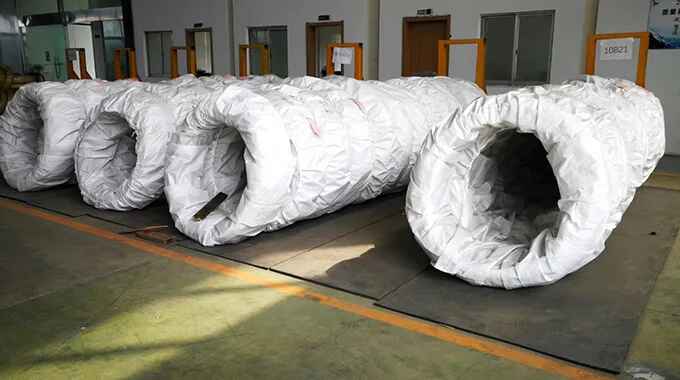
1. Delivery conditions and applicable requirements
Table C.1 – Combinations of heat-treatment condition at delivery, product form and applicable requirements
| Delivery condition | Symbol | Wire rod | Bar | Wire |
|---|---|---|---|---|
| Hot rolled or peeled | +AR or +PE | X | X | X |
| Cold drawn | +AR+C | — | X | X |
| Cold drawn and spheroidize annealed | +AR+C+AC | — | X | X |
| Cold drawn, spheroidize annealed and lightly cold drawn | +AR+C+AC+LC | — | X | X |
| Spheroidize annealed or spheroidize annealed and peeled | +AC or +AC+PE | X | X | X |
| Spheroidize annealed and cold drawn | +AC+C | — | X | X |
| Spheroidize annealed, cold drawn and spheroidize annealed again | +AC+C+AC | — | X | X |
| Spheroidize annealed, cold drawn, spheroidize annealed again and lightly cold drawn | +AC+C+AC+LC | — | X | X |
X = applicable; — = not applicable.
Other delivery conditions may be agreed at the time of order.
Applicable requirements according to the basis of order
| Ordered with reference to steel names in the tables | Requirement |
|---|---|
| C.2, C.3, C.4, C.5 or C.6 | Chemical composition according to C.2 and C.3; mechanical properties according to C.4, C.5 and C.6. |
| C.2, C.3, C.4, C.5, C.6, C.7, C.8 or C.9 | Chemical composition according to C.2 and C.3; mechanical properties according to C.4, C.5 and C.6; hardenability values according to C.7, C.8 and C.9. |
| C.2, C.3, C.4, C.5, C.6 or C.10 | Chemical composition according to C.2 and C.3; mechanical properties according to C.4, C.5 and C.6; minimum core hardness and maximum diameter according to C.10. |
Supplementary or special requirements under Annex E apply if agreed at the time of enquiry and order.
Source: ISO 4954:2018, Table C.1, page 34. This table gives the standard relationship between product form, delivery condition and requirements; actual supply must be confirmed separately.
2. Chemical composition
Table C.3 – Chemical composition of boron-alloyed steels for quenching and tempering (cast analysis)
These are the standard’s reference requirements for cast analysis of 30MoB1, not analysis results for a particular heat. The order standard and requirements for raw material and finished product must be confirmed separately.
| Element | Mass fraction, % |
|---|---|
| C | 0.28–0.32 |
| Si | ≤0.30 |
| Mn | 0.80–1.00 |
| P | ≤0.025 |
| S | ≤0.025 |
| Cr | ≤0.30 |
| Mo | 0.08–0.12 |
| B | 0.0008–0.005 |
| Cu | ≤0.25 |
Elements not listed must not be intentionally added without the purchaser’s agreement, except for finishing the heat. Appropriate precautions are required to prevent additions from scrap or other production materials of elements that could impair hardenability, mechanical properties or suitability.
Al of 0.020–0.050% may be added to improve cold-heading performance.
a: Single values are maximum limits unless otherwise indicated. A dash does not mean zero content.
b: For steels with hardenability requirements under Table C.8, small departures from the specified limits are permitted, except for sulfur and phosphorus. Departures must not exceed 0.01% for carbon or the values in Table 2 for the other elements.
c: A lower silicon content may be agreed at the time of order. Its effects on the specified properties, such as hardenability, must then be assessed.
d: Where a maximum chromium content of 0.30% is specified, a lower limit may also be agreed at the time of enquiry and order.
e: To achieve through-hardening to the core for 30MoB1, the lower Cr limit shall be 0.15% and may be agreed at the time of enquiry and order. For particular applications, a lower upper Cr limit may also be agreed at the time of enquiry and order.
Source: ISO 4954:2018, Table C.3, page 37 (PDF page 43). The table and notes do not replace the complete standard.
3. Mechanical properties
Table C.6 – Mechanical properties of boron-alloyed steels
| Steel name | Diameter | Delivery condition | ||||||||||||
|---|---|---|---|---|---|---|---|---|---|---|---|---|---|---|
| +AR or +PE | +AC or +AC+PE | +AR+C | +AR+C+AC | +AR+C+AC+LC | +AC+C | |||||||||
| over, mm | up to and including, mm | Rm max., MPa | Z min., % | Rm max., MPa | Z min., % | Rm max., MPa | Z min., % | Rm max., MPa | Z min., % | Rm max., MPa | Z min., % | Rm max., MPa | Z min., % | |
| 30MoB1 | 2 | 5 | — | — | — | — | — | — | 530 | 64 | 570 | 62 | — | — |
| 30MoB1 | 5 | 40 | — | — | 530 | 62 | — | — | 510 | 64 | 550 | 62 | 630 | 57 |
The tensile-strength values in delivery condition +AR are not compatible with the entire composition range for a steel grade in Table C.3. Compatibility between tensile-strength values and hardenability requirements must be checked for the supplied diameter and composition.
Source: ISO 4954:2018, Table C.6, page 43. Rm is tensile strength; Z is reduction of area at fracture. The values apply only to the specified diameter intervals and delivery conditions.
4. Hardenability requirements
Table C.8 – Hardness limits for boron-alloyed steels with specified normal hardenability (+H)
| Steel name | Symbol | Austenitizing temperature, °C (±5 °C) | Limit | Hardness, HRC, at distance from the quenched end, mm | ||||||||||||||
|---|---|---|---|---|---|---|---|---|---|---|---|---|---|---|---|---|---|---|
| 1.5 | 3 | 5 | 7 | 9 | 11 | 13 | 15 | 20 | 25 | 30 | 35 | 40 | 45 | 50 | ||||
| 30MoB1 | +H | 870 | max. | 53 | 52 | 52 | 51 | 49 | 48 | 46 | 43 | 34 | — | — | — | — | — | — |
| 30MoB1 | +H | 870 | min. | 47 | 46 | 45 | 39 | 30 | 24 | 21 | — | — | — | — | — | — | — | — |
Source: ISO 4954:2018, Table C.8, page 47.
Table C.10 – Minimum core hardness and maximum diameter for at least 90% martensite in the core-hardening test (+CH)
| Steel name | Symbol | Austenitizing temperature, °C (±5 °C), see note a | Minimum core hardness, HRC | Maximum diameter, mm, see note b |
|---|---|---|---|---|
| 30MoB1 | +CH | 870 | 45 | 18 |
a: As a guide, a holding time of at least 30 minutes at the hardening temperature is recommended.
b: The specified maximum diameters are achievable at the lowest hardenability within each steel grade. For +HH qualities, the maximum diameter may be increased.
Source: ISO 4954:2018, Table C.10, page 50.
These values are standard references for the specified test conditions. They do not confirm availability, suitability for a particular cross-section or a production heat-treatment procedure. Delivery requirements require technical assessment.