
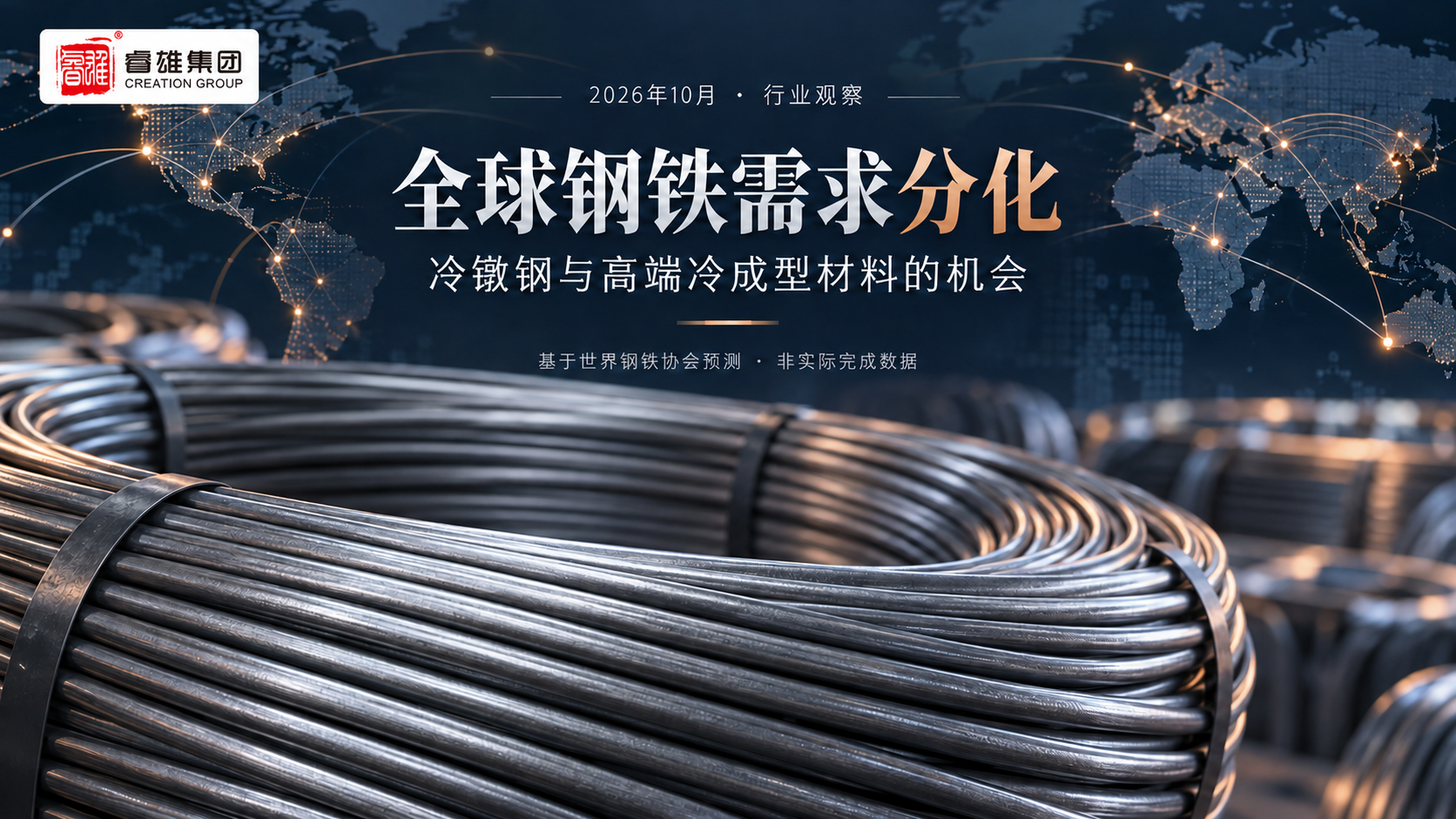
With steel demand growth slowing, should cold heading steel (CHQ) material companies contract or seek new growth opportunities? The World Steel Association’s short-term steel demand forecast released on October 12, 2026, provides a basis for observing the macro market, but it does not directly answer how much orders will grow for a specific grade, type of fastener, or kind of special-shaped wire.
Creation Group’s judgment is: first identify downstream applications, then assess material and process capabilities, and finally validate commercial returns. Regional growth serves as a research clue, but customer projects and actual manufacturing conditions are the true basis for business decisions.
I. Latest Forecast: Global Recovery Slow, Regional Disparities Widen
The World Steel Association forecasts that global steel demand in 2026 will be 1 722 Mt, virtually unchanged from 2025; in 2027, it will grow by 1.7% to 1 752 Mt. “Mt” stands for million tonnes. All figures below are forecasts, not actual completed data.
| Market | 2026 Forecast Growth Rate | 2027 Forecast Growth Rate |
|---|---|---|
| Global | Essentially Flat | +1.7% |
| China | -2.0% | -1.0% |
| Rest of the World | +1.5% | +4.0% |
| India | +7.9% | +8.0% |
| EU | -0.3% | +3.1% |
| US | +2.0% | +1.5% |
| Japan | +0.9% | +1.7% |
| South Korea | +1.8% | +1.3% |
Source: World Steel Association Short-Term Steel Demand Forecast, October 2026, released on October 12, 2026, based on available data as of early September 2026. This forecast remains subject to changes in the economic, trade, and energy environments.
II. China’s Total Demand Under Pressure—Material Selection Requires a Closer Look at Structure
The adjustment in the real estate sector, infrastructure investment trends, and manufacturing performance collectively influence China’s steel demand. For cold heading steel suppliers, the more relevant questions are: what components are customers producing, which applications are they serving, what material condition are they using, and whether new projects have already entered the trial production or mass production phase.
Automotive fasteners, mechanical connectors, and complex cold extrusion parts all have different manufacturing requirements. Even when using the same grade, dimensions, spheroidizing annealing state, surface quality, and lubrication needs may vary. A 2% decline in total steel demand cannot be directly translated into a 2% drop in cold heading steel demand; nor does relatively stable manufacturing performance necessarily indicate growth in a particular high-end material category.
III. Overseas Market Opportunities: From Regional Growth Rates to Specific Projects
India: Focus on Supply Chain Development, First Validate Customer Capabilities
The growth in Indian demand is worth continuous study, but infrastructure development remains a key driver. When developing cold heading steel (CHQ) material business, it is essential to further verify the product structures, equipment conditions, quality requirements, sourcing channels, and certification progress of local fastener and automotive component manufacturers. Relying solely on overall steel consumption growth to conclude that there is a supply gap for high-end cold heading steel would be premature.
Europe: Under Cost Pressure, Stable Manufacturing Is More Practical
The European automotive industry is under pressure; material suppliers should focus on specific platforms and component projects rather than making broad judgments about a “European market recovery.” For customers who have already established stable processes, material substitution requires trial production and validation; lower per-ton prices may not offset costs caused by downtime, cracking, die wear, or quality fluctuations.
United States, Japan, and South Korea: Track Demand by Application
Investment in U.S. data centers and energy infrastructure provides market signals, but new steel consumption involves multiple grades and cannot be directly equated with cold heading steel orders. The moderate recovery in Japan and South Korea also needs to be tied to specific customer projects. Actual development should first confirm the function of connectors or formed parts, then assess the corresponding materials, processes, and supply conditions.
IV. Three Types of Material Business Opportunities Worth Exploring
1. Steel for Automotive Fasteners: Convert Stability into Measurable Metrics
In addition to chemical composition and specified mechanical properties, it is necessary to verify spheroidized structure, decarburization, inclusions, surface defects, dimensions, and batch consistency according to applicable standards, customer drawings, and technical agreements. For safety-critical components, material acceptance, process validation, and customer approval requirements must be clearly defined. Compliance with a particular material standard does not automatically mean customer certification has been achieved.
2. Complex Cold Forming Materials: Validate in Combination with Equipment, Tooling, and Lubrication
The performance of materials used for complex cold heading and cold extrusion parts must be evaluated alongside the actual deformation path, equipment capabilities, tooling design, and lubrication conditions. During trials, record crack locations, loads, die wear, and first-pass yield, while retaining material heat numbers and processing states to enable traceability and comparison of process issues.
3. Special-Section Wire Rods: Demonstrate Value Through Total Part Cost
Hexagonal, square, flat, and other special-section wires may reduce subsequent forming or machining operations when used appropriately. Whether they are worth adopting should be assessed by comparing material utilization, dimensional accuracy, post-processing time, tooling costs, first-pass yield, and order continuity. The value of shaped wire lies in specific manufacturing benefits; its economic advantage cannot be assumed merely because of its unique cross-section.
V. Risks and Actions: Turning Market Assessments into Project Checklists
- Demand Risk: Treating macroeconomic growth rates as customer orders. Action: Verify end-use applications, current projects, and customer capacity utilization.
- Technical Risk: Mistaking compliance with standards for stable mass production capability. Action: Agree on material condition, trial manufacturing conditions, evaluation criteria, and acceptance responsibilities.
- Development Risk: Rising technical complexity while orders fail to cover the investment. Action: Calculate development, tooling, inspection, changeover, and quality costs.
- Supply Chain Risk: Regional demand growth accompanied by changes in delivery and trade terms. Action: Confirm applicable rules, transportation, payment, and customer approval requirements for each project.
For materials companies, it is advisable to first establish a checklist covering “application—part—material—process—validation—commercial terms”: use clearly defined customer part requirements as the starting point, validate technical value through samples and production records, and assess profitability based on the total cost per qualified product.
Creation Group Observation: Growth Opportunities Must Stand Up to Manufacturing Site Testing
The divergence in global demand provides directions for market exploration. For cold heading steel (CHQ), automotive fastener steels, and high-end cold forming materials, projects truly worthy of investment should simultaneously feature clear application needs, verifiable quality requirements, and sustainable commercial terms.
Creation Group focuses on the synergistic application of cold forming materials and special section wires. We welcome submissions via our website of grade and standard information, dimensions and delivery conditions, part usage, drawings, and trial manufacturing issues, so that we can jointly map out verifiable material and process pathways.
Sources and Scope of Analysis
World Steel Association: worldsteel Short Range Outlook October 2026, published on October 12, 2026. The macroeconomic data presented are the association’s forecasts; the analysis of opportunities and risks for cold heading steel, special wires, and automotive fastener materials represents Creation Group’s industry assessment based on publicly available information, and does not constitute the World Steel Association’s forecast for specific market segments, nor does it serve as a supply or performance guarantee.